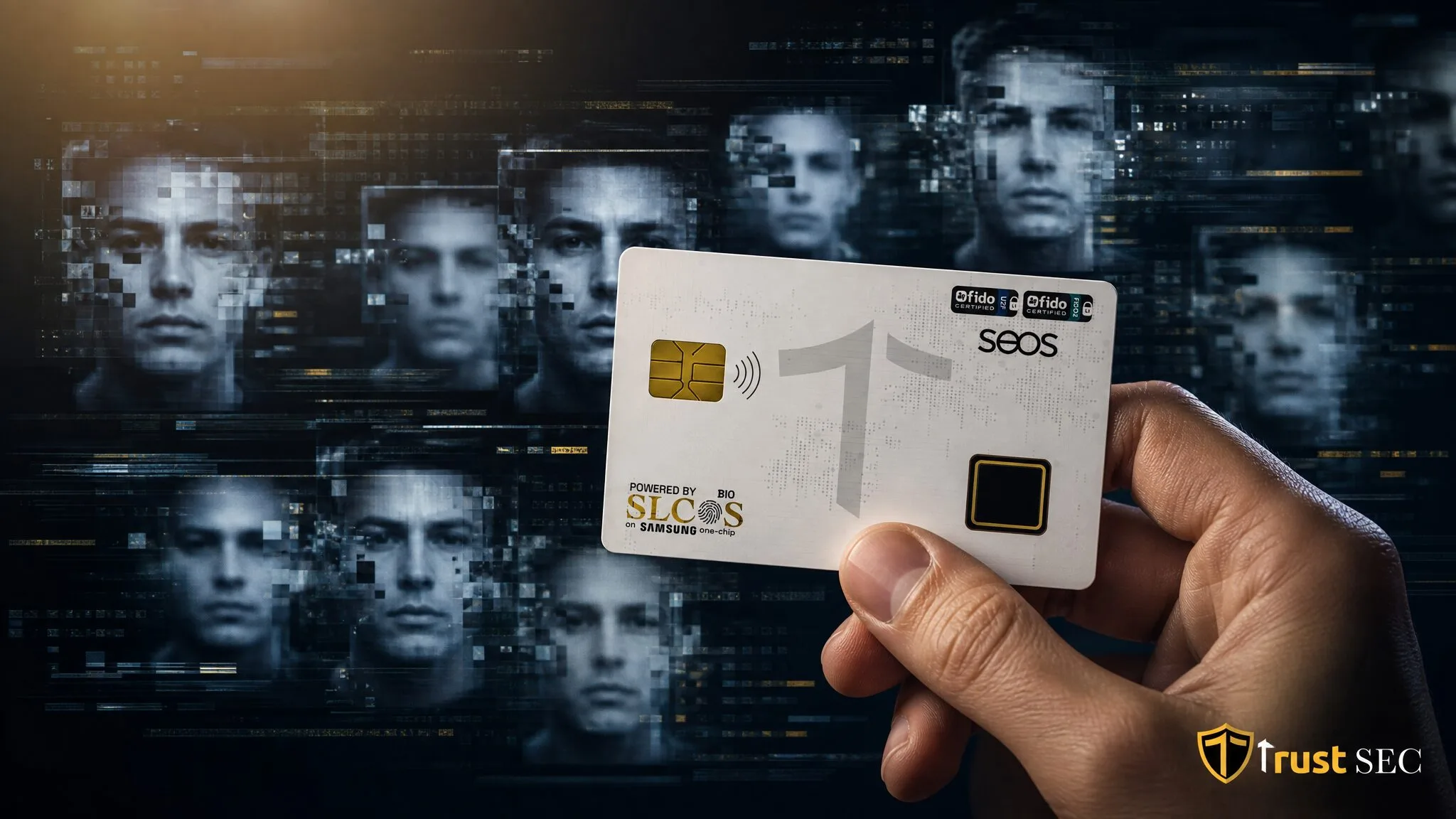
A finance employee just wired $25M after a video call with their CFO and four colleagues.
Every single person on that screen was an AI deepfake.
This isn’t a future threat model, it’s the current reality of social engineering. And it exposes the fundamentally broken assumption underlying most Multi-Factor Authentication (MFA):
Relying on a human being to make a judgment call under pressure.
Whether it’s an SMS OTP, a voice prompt, or a push notification, traditional MFA ends with a human typing a code or tapping “Approve.”
Now that voice cloning and real-time face-swapping are available as low-cost subscription services, adversaries don’t need to break your cryptography. They simply talk your employees into surrendering the factor.
If a human can read it, type it, or tap it, an AI can trick them into passing it along.
The Fix: Eliminate Human Judgment from the Trust Model
To defeat synthetic media and real-time proxy attacks, the root of trust must move into physical hardware that a human—or an AI impersonating one—cannot hand over.
Here is why true Phishing-Resistant MFA (FIDO2 / PKI) changes the equation:
- Non-Exportable Keys: Private keys are generated and sealed within a dedicated Secure Element. They cannot be extracted by the OS, a phisher, or the user themselves.
- Cryptographic Domain Binding: Authentication is tied to the exact WebAuthn domain origin. On a spoofed site, the key simply produces no valid signature—the protocol itself rejects the wrong origin before a human ever gets a chance to be fooled.
- Physical Presence Verification: A physical touch or biometric scan confirms local user presence. There is zero transmittable secret for a deepfake to relay.
A cloned voice can be convincing. A deepfake video can be flawless. But neither can talk a hardware key into signing an authentication request for the wrong domain.
The Real Vulnerability
Deepfakes didn’t out-calculate modern security they exposed authentication methods that still depend on human certainty.
As synthetic media scales, “trusting the user to verify” is no longer a security control. It is a vulnerability.
The only thing left unfakeable is the hardware key in your hand.
Where is your organization still relying on human judgment inside the authentication chain—and what’s slowing the move to phishing-resistant MFA?
Let’s discuss below.
Website: www.trustsec.net
#Cybersecurity #DigitalIdentity #FIDO2 #ZeroTrust #PKI #Passkeys #InformationSecurity #CISO